
The privacy layer for onchain finance. Live on Monad and World Chain.
Last week on The Rollup, Morpho’s Merlin Egalite was asked what is holding banks back from putting their customers onchain. He did not hedge. Morpho is onboarding large asset managers and banks, those institutions have privacy constraints, and they have to protect the confidentiality of their customers. Scaling to all of those customers takes a privacy layer, and in his words, “we don’t have one at the moment.”
He is describing the wall every institution hits. The ledger everyone shares is the ledger everyone reads. Balances, counterparties, position sizes, payroll. Published, permanently, to every competitor with a browser.
Today Merces goes live on mainnet. Real funds, starting on Monad and World Chain.
Four years to get here
TACEO spun out of TU Graz in July 2022 founded by cryptographers whose work underpins the field: Poseidon, used across most of the ZK ecosystem, and SPHINCS+, now a NIST post-quantum standard. We set out to build one thing: verifiable encrypted compute. You can compute on encrypted data without ever having access to it, and you can prove to everyone which computations were performed.
For two years that was research and engineering. In 2024 it met the hardest test available. World needed to check whether a new iris code already existed in its database, in real time, at global scale, without any operator ever holding a template. We built the protocol, co-authored the paper with their team, and shipped it.
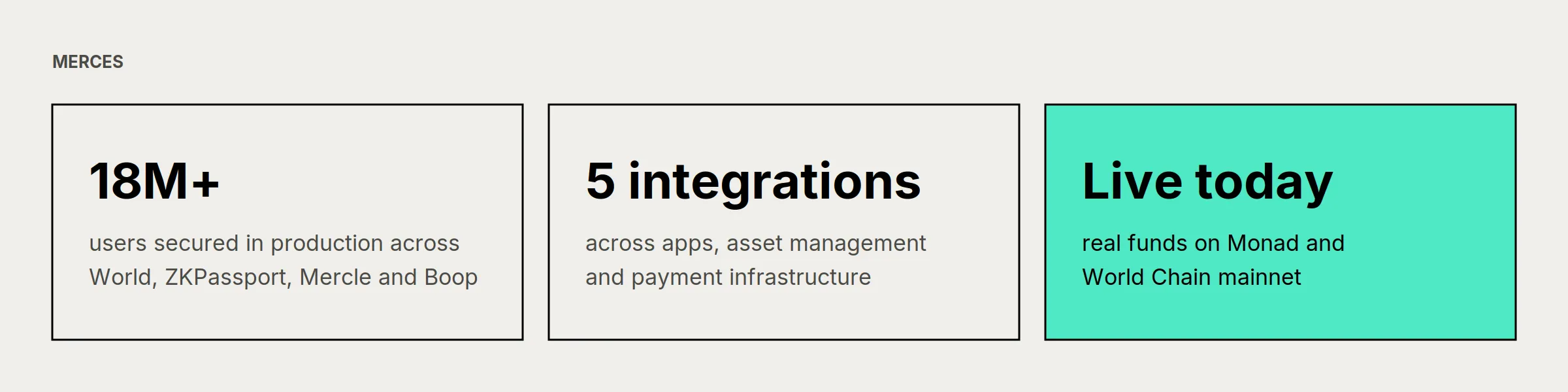
It worked and it scaled. The TACEO Network now secures over 18 million users across World, ZKPassport, Mercle, and Boop, in 160 countries. Biometrics is the most sensitive data there is. Our protocols have been carrying it in production for almost two years.
A year ago we started building finance on the same foundation. That is Merces.
What you get
Merces is a privacy layer for onchain finance. It sits on the public chain rather than replacing it, so institutions keep the settlement, interoperability and composability that brought them onchain in the first place while their financial activity stays private. Here’s what that means in practice.
Full privacy — amounts and accounts are both hidden. Balances are private and so are the accounts they belong to. Not just the size of a transfer, but who holds what and who pays whom, concealed onchain.
Shared state, not just private transfers. A private register that enforces eligibility, holder limits and pro-rata yield across every holder at once. That is what a fund, a vault or a netting arrangement needs, and it is not something a private transfer can give you.
It is not a chain you have to move to. Merces is a chain-agnostic privacy layer. Your assets stay your assets. Your clients keep their wallets. Nothing in your stack gets rebuilt. It runs on Monad and World Chain today, deploys on any chain. Integration takes weeks rather than months or years, through an SDK that drops into your existing system.
Compliance built in. Screening happens before a transaction executes, through Predicate. When an auditor or a regulator asks for a record, you can produce that record and nothing around it.
Throughput for real customer bases. 1,000 transactions per second today.
Who this is for
If you run a neobank, your customer list is the asset. If you issue tokenised funds or treasuries, your holder register is. If you are a payments company, it is your counterparties and your volumes. All of it is currently the price of admission to a public chain, and for most institutions that price has been too high to pay.
That is the constraint Merces removes. Everything below is someone who has already started building against it.
Who is already building
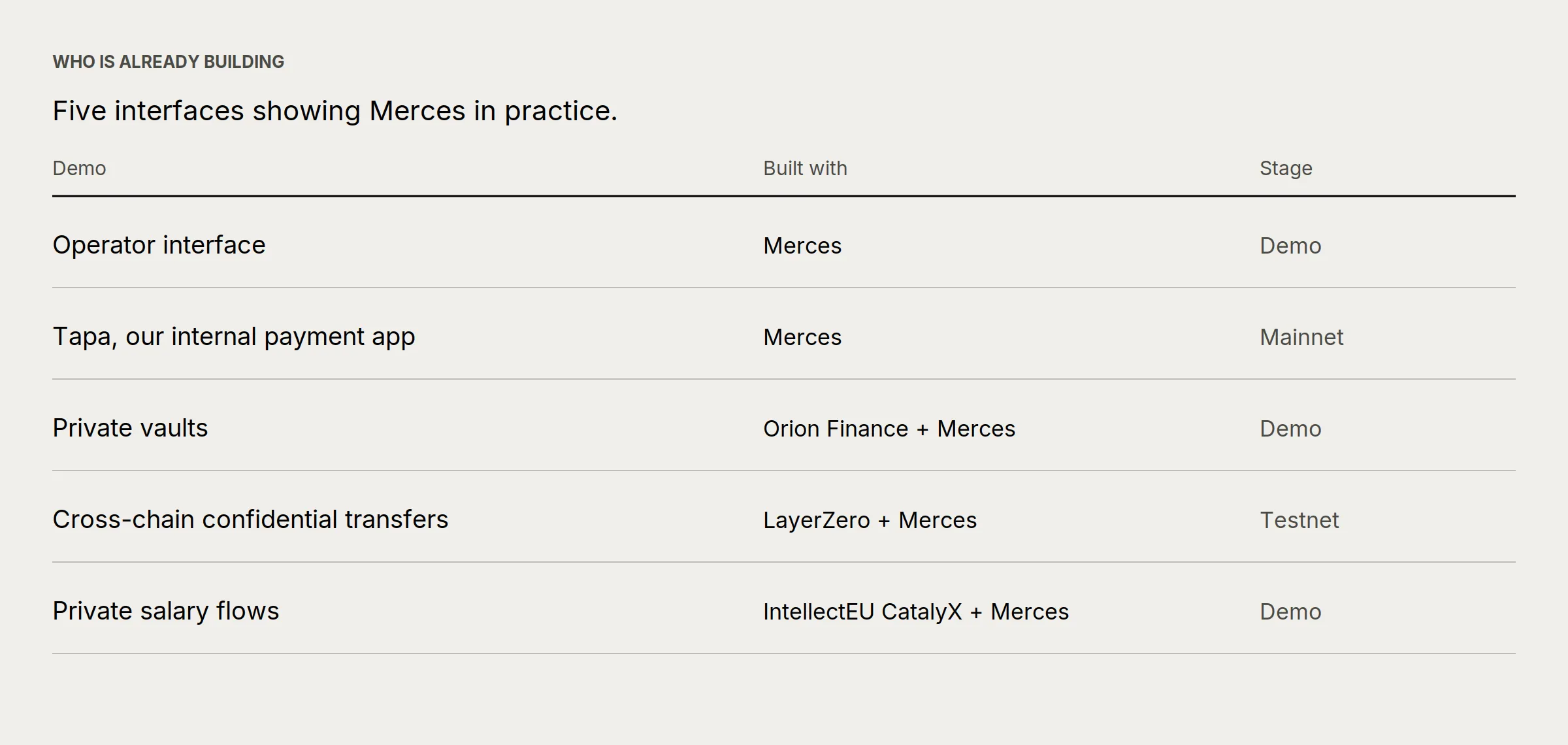
Four partners are building on Merces, across four different parts of the stack: orchestration for banks, cross-chain messaging, asset management, and tokenised treasuries. Here is what Merces looks like as part of a working stack.
IntellectEU has been building DLT integrations for banks and market infrastructures since the early enterprise wave, across Swift messaging and multiple ledger stacks. They are integrating Merces into their CatalyX platform.
Our clients will run Swift messaging, Canton and other public chains side by side for years, and confidentiality has to hold across all of them. No bank is going to rebuild a payment stack that already works to get there. The orchestration layer in CatalyX sequences the payment across those rails, and TACEO Merces keeps it confidential, that’s the integration we’re building.
— Jonathan Mayeur, Head of Product, CatalyX and IntellectEU
LayerZero enables private cross-chain transfers through Merces, so confidential balances can move between chains.
Multichain distribution settled the question of how value moves between networks seamlessly, but the question of privacy remained open. We are building with TACEO so confidential balances can travel between chains while shielding the participants and size of the transfer.
— Cameron Nili, Banking & Capital Markets Lead, LayerZero
Orion Finance builds multi-vault infrastructure for tokenised investment products. We are working together on making those vaults private while keeping performance verifiable to investors.
A portfolio manager who publishes every rebalance is giving away the thing they are paid for. That is a large part of why serious managers have stayed off public rails. We are working with TACEO on vaults where allocations stay private and performance stays verifiable to the people who invested in them.
— Matteo Manzi, CEO and co-founder, Orion Finance
Zenith is the canonical EVM and SVM extension for Canton Network, running natively inside Canton’s infrastructure, where DTCC tokenises US Treasuries. Merces brings private shared state to that environment.
Institutional DeFi needs a few pieces to work at once: programmability, settlement, and privacy. Zenith is bringing EVM compatibility to Canton so institutions can use DeFi tooling without leaving the network they settle on. Privacy is the piece that’s still missing across this market, and TACEO taking Merces live on mainnet with real funds is a real step toward closing that gap.
— Norbert Vadas, Head of Product, Zenith
We use it ourselves. Tapa is our internal payment app, live on Monad mainnet. The whole company uses it with real funds, including the fines for turning up late to standup.
What it looks like in a product. An operator console for a neobank, a private vault, cross-chain transfers. Merces is the layer underneath each of them.
So what makes Merces different
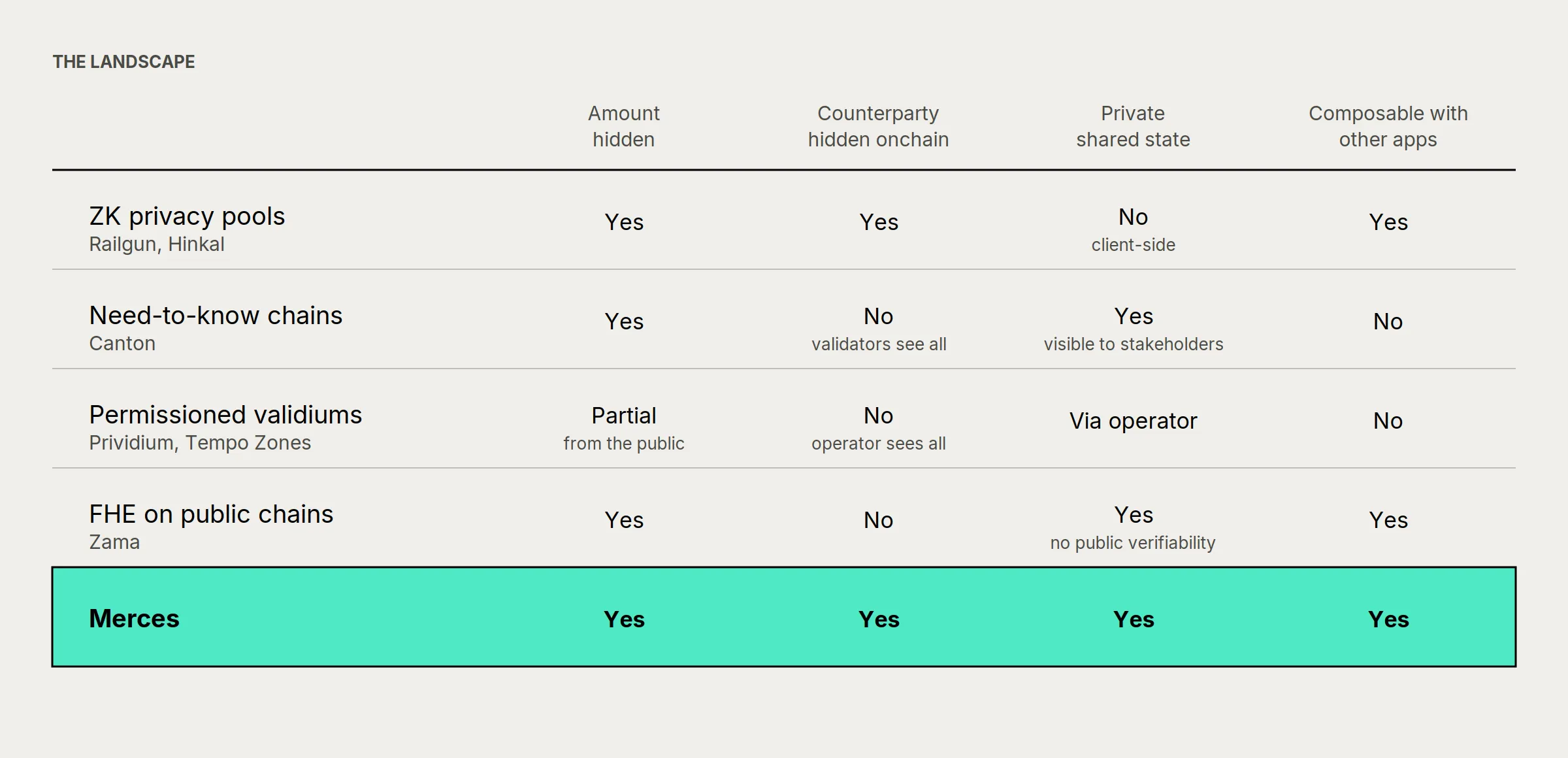
Shared state. Most privacy on public chains protects a transfer between two parties. Finance needs more than that. For example, a tokenised fund has to enforce eligibility, holder limits and pro-rata yield across every holder at once, without anyone seeing who those holders are or what they own. Netting between banks is the same problem. So is a vault rebalancing across positions.
Merces computes over state that is split across independent operators, so the rules get enforced without any single operator holding the picture. Every other approach gets you part of this and gives up the rest: privacy that only works per user, or shared state that someone has to be able to read.
How it works
Balances and identifiers are secret-shared across the TACEO Network. Financial logic runs via multiparty computation over those shares. No node ever reconstructs a readable balance.
The network then produces a collaborative zero-knowledge proof, a coSNARK, asserting that the state transition followed every rule. A contract on the host chain verifies it before it counts. The network cannot forge a balance, move funds, or write a state it cannot prove. Correctness does not depend on our nodes behaving, it depends on the chain checking the proof.
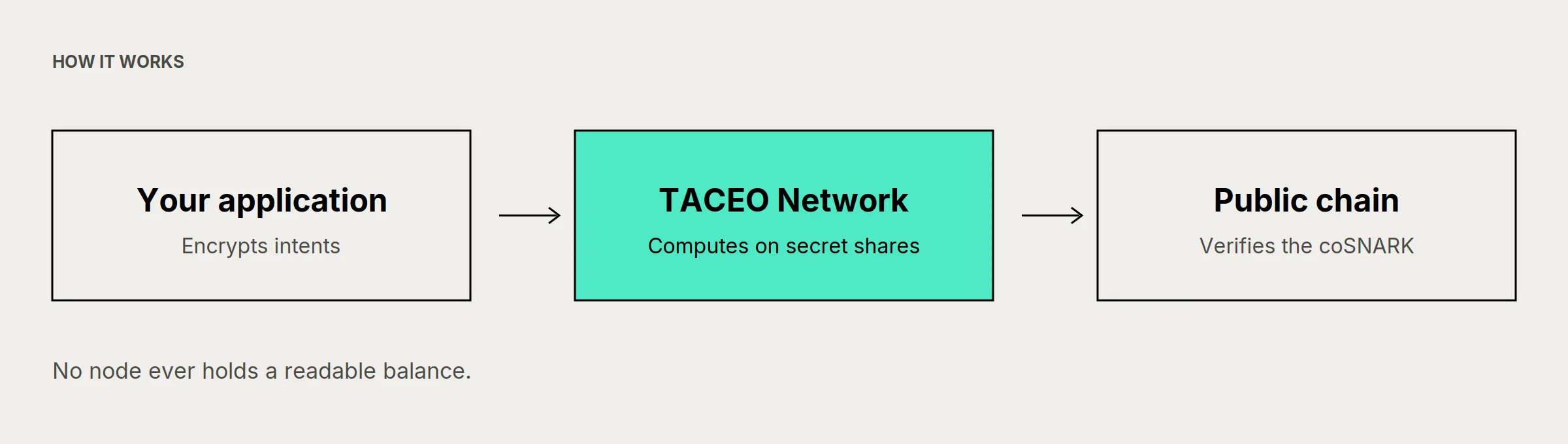
An observer sees that the state changed and that the change was valid. Nothing else.
The MPC core is post-quantum resistant. Full architecture → Protocol specification: IACR ePrint 2026/850 →
Where it runs
Live on mainnet: Monad, World Chain.
Testnet: Arc, Base, Ethereum, Plasma, Stable.
Deployable on any chain.
Your turn
Institutions have spent years deciding between the efficiency of public rails and the privacy their customers are owed. That decision is no longer necessary.
Documentation and client SDKs: docs.taceo.io
Protocol formalisation: IACR ePrint 2026/850
Talk to us about integrating Merces: [email protected]
