

Institutions need two things from financial privacy at once: to protect what they do, from competitors and counterparties, and to prove what they did, to regulators and auditors. Stablecoins are becoming payment infrastructure, and public chains offer neither by default: balances and payments are visible to anyone who looks. Merces was built for exactly this need, with compliance inside the definition rather than bolted on. There is no institutional privacy without a way to prove what happened.
Regulators increasingly see it the same way. The US Treasury’s recent GENIUS Act report acknowledges that people have legitimate reasons for financial privacy on public blockchains, and frames the policy goal as countering illicit finance while protecting privacy. The question is no longer whether privacy and compliance can coexist. It’s who builds the systems where they do.
Today we’re announcing the integration of one: Predicate now powers automated compliance enforcement in Merces.
Compliance is two problems, not one
Compliance for private payments splits cleanly in two, and the halves sit on opposite sides of the transaction.
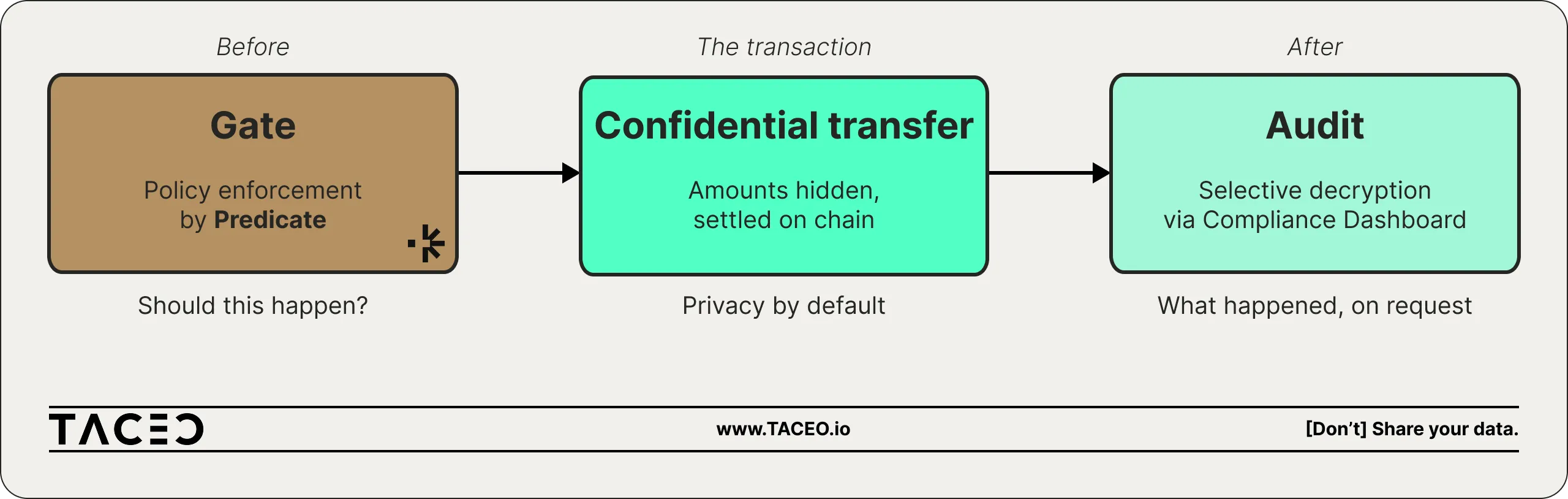
After a transaction, an auditor needs to inspect it. A regulator issues a lawful demand. A compliance officer reviews a flagged transfer. This is disclosure of past activity, on request, to authorised parties, and it has been live in Merces since March through the Compliance Dashboard: authorised users can request decryption of specific transactions for regulatory purposes, and no details beyond the requested transactions are exposed.
Before a transaction, the question is different: should this transfer happen at all? Sanctions screening, AML checks, policy gating. This is enforcement, and it’s what ships now with Predicate.
Gate and audit. Institutions need both, and both are now in our solution for private finance.
What ships
Merces was designed with a Compliance Engine: a slot in the architecture where a policy provider plugs in and checks transactions before they settle. Predicate now fills that slot.
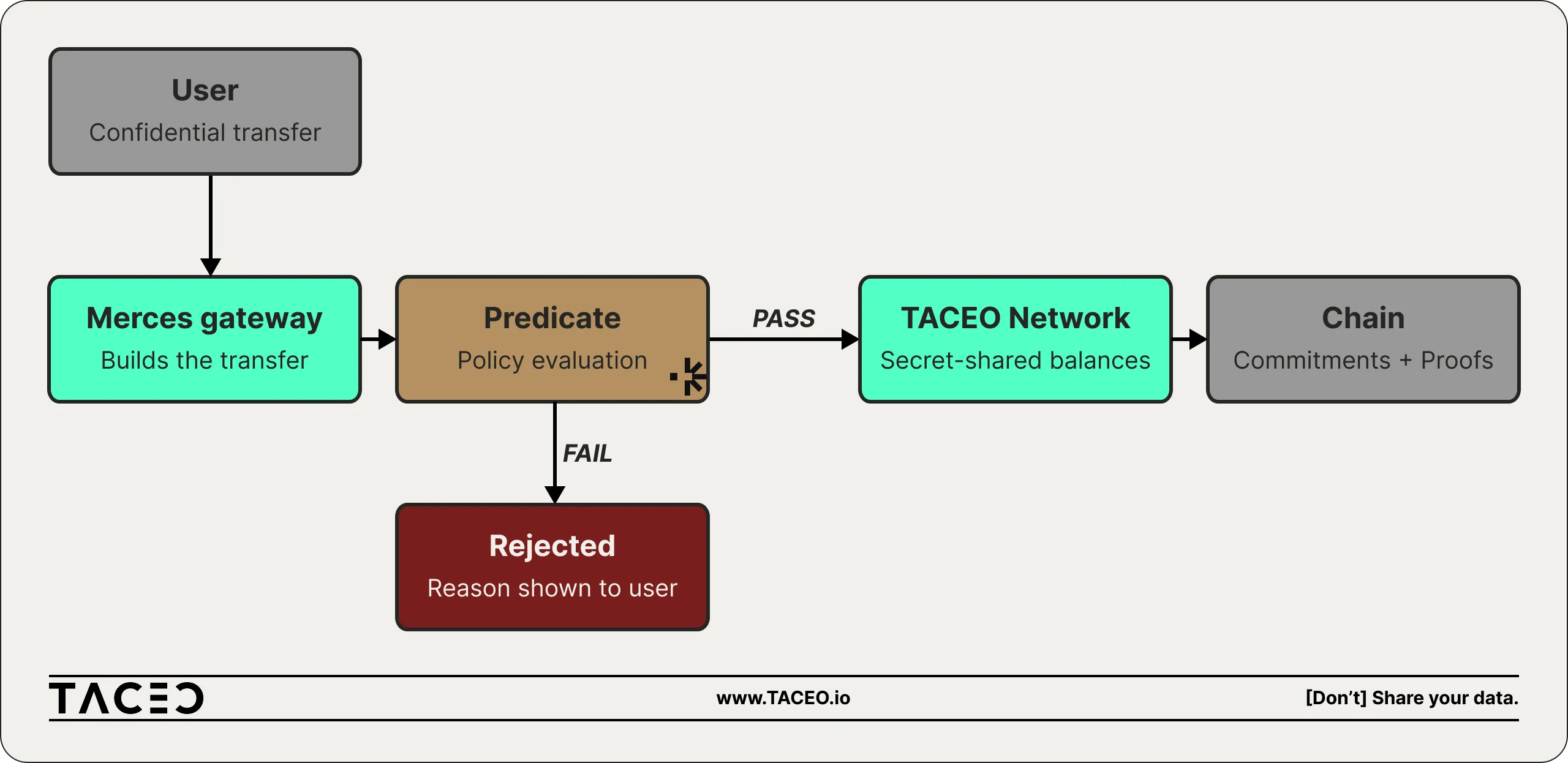
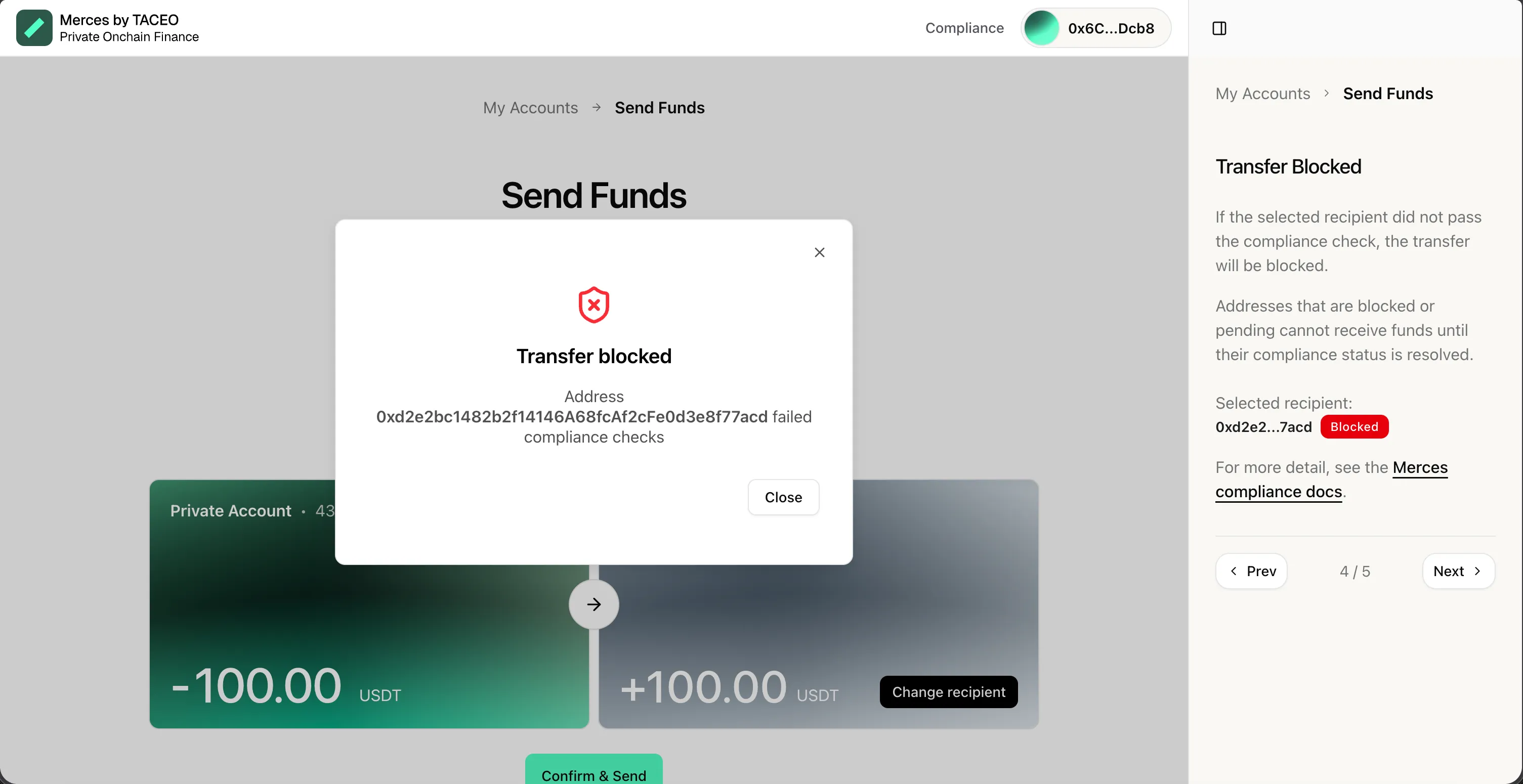
Predicate is programmable compliance infrastructure, already deployed with Paxos, Consensys, M0, Aztec, and Aleo. When a user initiates a confidential transfer in Merces, the gateway submits it to Predicate’s policy engine, which evaluates it against the operator’s configured policy: AML and CFT screening and sanctions lists. Compliant transfers proceed. Non-compliant transfers are rejected, with a structured reason returned to the user.
The policy sits with the operator. Predicate enforces the rules the institution defines, on every transfer, and policies can be updated as regulations change, without touching the deployment.
Built in, not bolted on
The division of labour is clean. Predicate handles policy evaluation and enforcement. TACEO handles privacy-preserving storage and controlled disclosure. Together, a full compliance stack with no plaintext data trail.
The news isn’t that Merces now does compliance. Compliance was in the architecture from the beginning; the Compliance Dashboard has been proving the disclosure half since March. The news is that a category-leading compliance partner now occupies the enforcement half, and the design works.
Privacy is critical for institutional adoption, but organizations must navigate business, legal, and regulatory requirements. Merces has enabled exactly what businesses need by making compliance enforcement possible before a transaction can be executed.
— Nikhil Raghuveera, Co-founder and CEO, Predicate
Compliance was a slot in the Merces architecture before it was a feature. Institutions told us the same thing over and over: they don’t want privacy that locks out their obligations. Predicate is the first partner in that slot, and it works exactly as designed: their policy engine decides what’s allowed, our cryptography keeps everything else private.
— Lukas Goetz, Co-founder and CPO, TACEO
What’s next
More policy types and deeper integration are all extensions of the same architecture, and the same Compliance Engine serves every operator that deploys Merces, whatever their regulatory surface looks like.
The architecture was built so regulated institutions don’t have to choose between privacy and compliance. This release is the demonstration.
If you’re building payments, treasury, or settlement on stablecoins and compliance has been the blocker, we want to talk: reach out about a design partnership. The integration is live to try in the Merces app, and the technical detail is in the docs.
