
The TACEO Network is a private execution layer for digital rails. It encrypts and distributes sensitive data across independent node operators so that no single party controls the data, the keys, or the outcome. The cryptographic infrastructure behind the network has been deployed in production systems used in World ID, supporting proof of human verification for nearly 18 million people.
Today, we are publicly launching the TACEO Network and opening it to new applications.
The Missing Layer
Digital systems increasingly depend on shared infrastructure. Payments run on global rails. Identity is going digital, and interoperable digital identity will define what we can do online and how easily we can do it. AI agents interact across platforms. The more shared these systems become, the more sensitive the data they handle.
Coordination layers exist. Blockchains handle consensus. Clearing networks handle settlement. But the execution of sensitive logic beneath these systems, identity checks, fraud scoring, uniqueness verification, is typically solved using centralized services. Still controlled by single operators and trusted intermediaries.
The TACEO Network introduces a new model: private shared state, where multiple parties can compute together while keeping their inputs confidential.
In practice, this means an application can ask specific questions about a user, “are they a citizen of this country, are they on a sanctions list, do they have an existing account,” and receive verifiable answers without ever seeing the underlying data. The computation happens on encrypted fragments across independent nodes. The answer reveals only the fact that was asked for, nothing more. The user controls what is shared and when.
This is what private shared state makes possible: applications that can verify, compute, and coordinate on sensitive data without any party, including the network itself, learning more than they need to.
A Service-Based Private Execution Layer
The network grows through purpose-built privacy solutions, assembled from a suite of composable cryptographic services and integrated directly into applications.
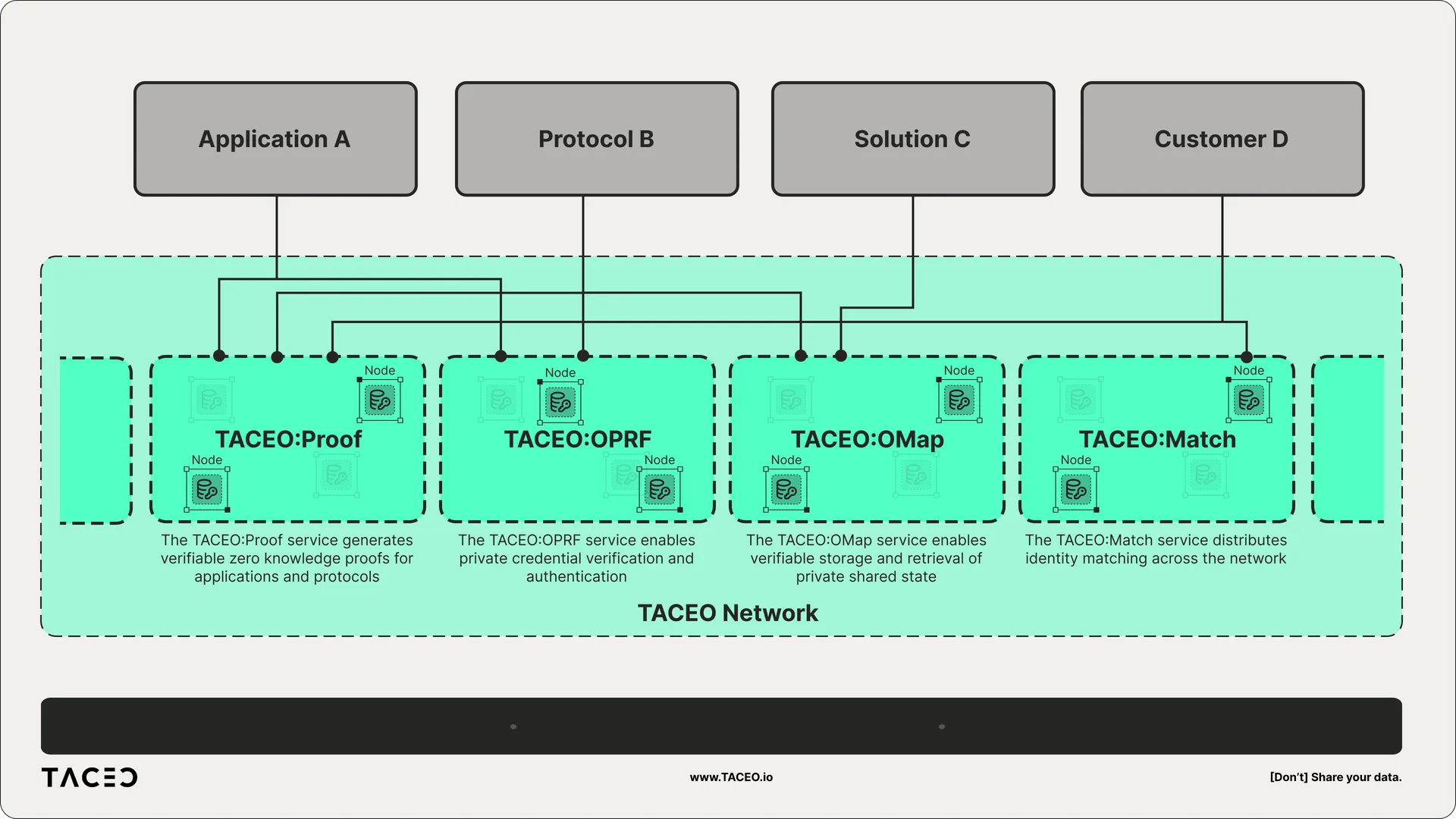
TACEO:Proof leverages Multi-Party Computation (MPC) + coSNARKs to generate verifiable zero knowledge proofs for applications and protocols. Live in production.
TACEO:OPRF enables private credential verification and authentication. The core primitive powering World’s uniqueness verification. Live in production.
TACEO:OMap enables verifiable storage and retrieval of private shared state. The foundation for private ledgers, registries, and financial infrastructure. Deployed, onboarding first applications.
TACEO:Match distributes identity matching across the network so no single party holds raw biometrics data. In active integration.
Real Workloads From Day One
The TACEO Network launches with production workloads already running on the network.
Applications integrate privacy services through APIs that route confidential computation to committees of MPC nodes operated by independent node operators on the network.
Several applications are already running on the network today.
World uses it across the World App, for proof of human uniqueness verification at global scale, securing nearly 18 million people (read more: Introducing World ID 4.0).
Building systems at global scale is challenging — doing so in a privacy-preserving way even more so. Verifying humanness globally required developing new approaches to privacy-preserving computation. Over the past two years, we’ve been working closely with TACEO to build and deploy the cryptographic infrastructure used in World ID. It’s exciting to see this infrastructure open up to a broader ecosystem of applications.
- Philipp Sippl, Director and Head of Engineering at World Foundation
ZKPassport uses it for private credential verification, allowing attributes to be verified without revealing personal data. ZKPassport also operates a node on the network, both building on the infrastructure and helping run it.
Other applications are currently undergoing testing and we will be sharing more very soon.
A Growing Network of Operators
The TACEO Network is operated by a distributed set of independent node operators that contribute compute resources to run the network’s cryptographic services.
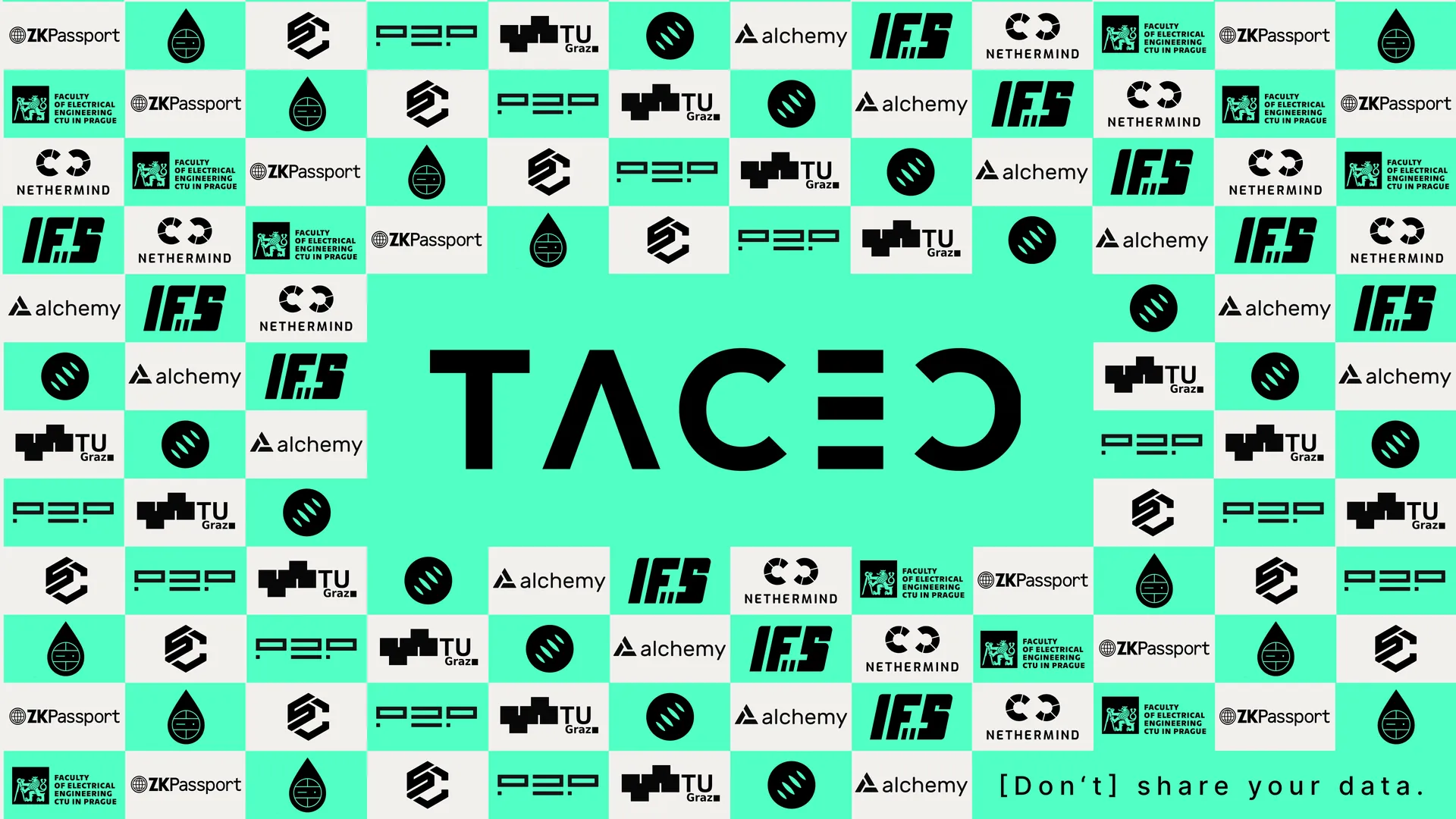
Initial node operators include:
Infrastructure operators: Nethermind, P2P.org, InfStones, Stakecraft, Moonli, H2O Nodes and ZKPassport run validators and node infrastructure across major protocols, with SOC 2 audits and years of uptime.
Academic node operators: CTU Prague, Faculty of Electrical Engineering and TU Graz are among the most reputable technical faculties in Europe. They operate nodes on the network and advance the cryptography behind it.
The RPC infrastructure is powered by Alchemy.
The teams running the protocols and the labs advancing the science operate the same network.
Nethermind operates infrastructure where correctness and reliability are non-negotiable. MPC networks like TACEO’s represent serious engineering, and that’s the kind of work we want to be running in production.
- Mateusz Jedrzejewski, CIO, Nethermind
Why Now
Until recently, running privacy-preserving computation at scale was impractical. MPC protocols were orders of magnitude too slow for production workloads. Bootstrapping a decentralized network of compute nodes was an unsolved coordination problem.
Over the past years, the practical performance of our MPC protocols has improved by four orders of magnitude. The TACEO Network can now perform billions of comparisons per second on encrypted data, enabling real-time verifications across identity systems with millions of users.
At the same time, the market need has become urgent. Stablecoins are putting privacy in the spotlight: corporate treasury strategies, payroll flows, and consumer transactions cannot be exposed on public ledgers. Financial infrastructure needs confidentiality without sacrificing compliance. Meanwhile, the agentic economy is emerging. Autonomous agents will need identity, they will need payments, and those systems need to be private and verifiable from the start.
The technology is ready. The demand is here.
What Comes Next
The TACEO Network is live with production workloads already running. The immediate focus is bringing more applications onto the services available today: Proof, OPRF, OMap, and Match can support additional identity, credential, and financial workloads without requiring teams to build their own private execution environment from scratch.
The infrastructure will continue to harden. Hardware-backed attestation through TEEs will give node operators stronger guarantees that approved software is running as expected. Governance will broaden over time to include a wider set of participants as more applications and operators join the network.
Identity systems are becoming programmable. Payment rails are incorporating complex routing and risk logic. Autonomous agents are beginning to transact across infrastructure.
The TACEO Network does not replace blockchains. It does not replace cloud. It provides the execution layer beneath both, built for the sensitive logic that cannot run publicly and should not concentrate risk in a single operator.
The network is live. Plug in the missing layer:
Documentation: Explore the network architecture, APIs, and developer tools at docs.taceo.io/taceo-network
Dashboard: Monitor network activity and service usage through the TACEO dashboard [Coming Soon!]
Node Operators: Operators interested in running infrastructure for the network can apply to participate as node operators. Reach out to the team / Email us: [email protected]
Partnerships: Organizations interested in integrating privacy services into their applications are encouraged to reach out to the TACEO team / Email us: [email protected]
