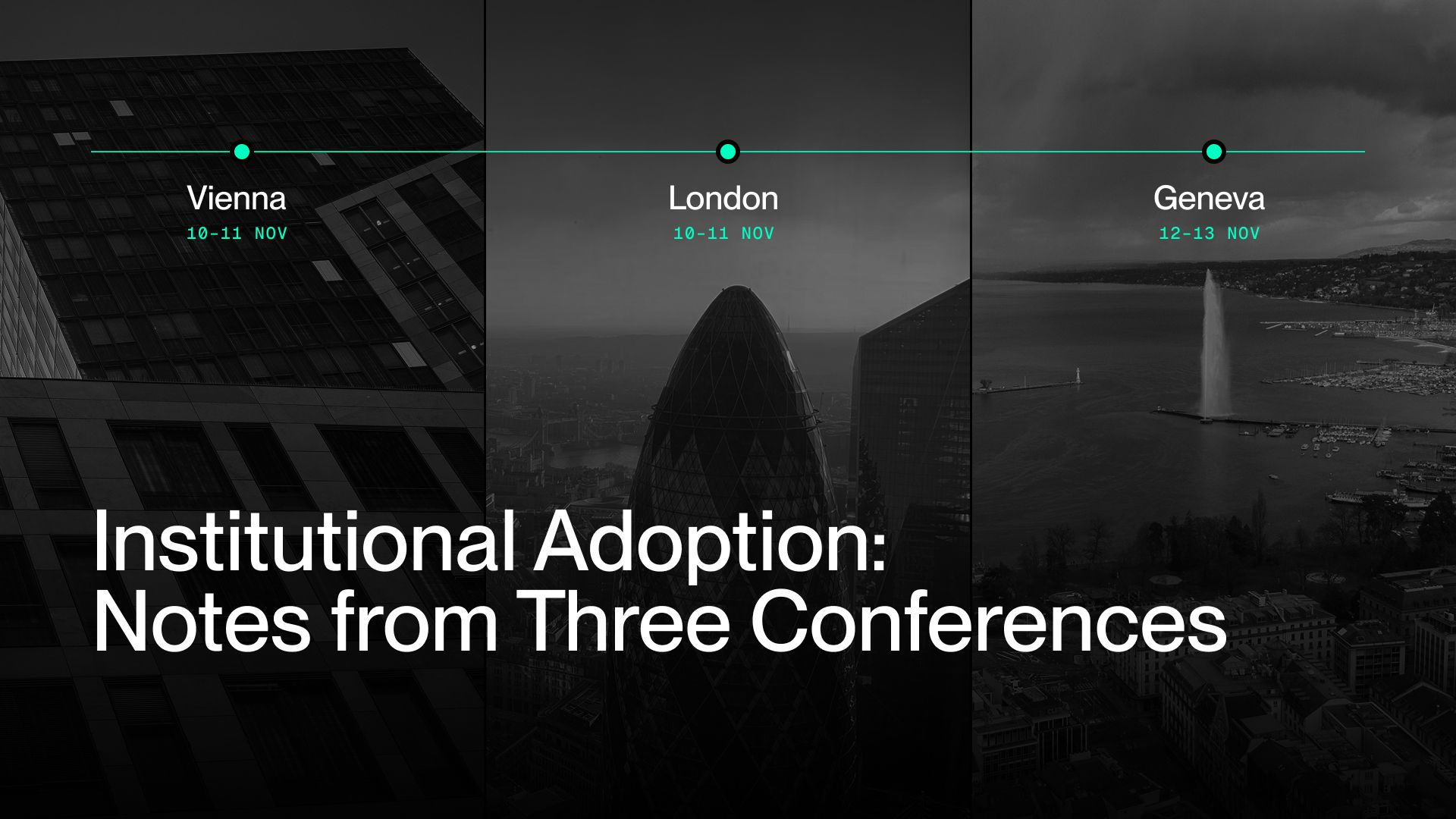

Three conferences in Vienna, London, and Geneva brought together different parts of the digital asset industry. Across their discussions, a common direction emerged: institutional adoption is progressing, but the requirements for making blockchain work in financial markets are becoming increasingly specific.
Key takeaways
- At the Digital Asset Summit in London, institutional conversations moved from exploration towards planning and implementation, and client requirements are becoming more specific.
- Private banks were strongly represented at The Geneva Summit, as their clients increasingly ask for access to digital assets.
- Security was the main theme at Bluechip26 in Vienna, with recent exploits, including the Binance hack, mentioned in nearly every talk. In Geneva, views on post-quantum risk varied widely.
- Two privacy misconceptions persist: that compliance requires revealing sender and receiver, and that permissioned networks do not need privacy, even though validators or operators may see every transaction.
Three events, a changing industry
Between 10 and 13 November, TACEO participated in three industry conferences across Europe. In Vienna, Bluechip26, The Crypto Safety Conference, brought together key players from Austria, the wider DACH region, and other parts of Europe, with Lukas Goetz representing TACEO. In London, Aisling Connolly and Filip Versluys represented TACEO at the Digital Asset Summit, where discussions covered stablecoins and global payments, tokenised assets, and digital asset policy. In Geneva, The Geneva Summit gathered senior decision-makers from banks, asset managers, regulators, and institutional firms, with Lukas Helminger and Filip Versluys representing TACEO.
Although each event brought a different perspective, the contributions from TACEO’s attendees point to several developments shaping the next phase of institutional blockchain adoption.
From exploration to implementation
One of the clearest observations from London was the shift in institutional conversations. Discussions are becoming more targeted, moving beyond initial exploration towards planning and implementation.
The infrastructure layer is increasingly established or at least in pilot, with both traditional technology providers and newer infrastructure teams contributing to its development. At the same time, the discussion around permissioned networks and public blockchains is becoming more nuanced. Many of the teams with a technical presence at the events expressed an interest in building on public chains from day one.
For financial institutions, however, the question is no longer simply whether blockchain can support their activities. It is increasingly about how existing processes and infrastructure need to evolve to meet specific business requirements.
As Filip Versluys observed, client demands are becoming more precise and are influencing how institutions approach implementation. Treasury teams, for example, are looking for greater flexibility, while access to financial market infrastructure around the clock brings different requirements for collateral management.
Design principles and new standards are also taking shape across regions and regulated market infrastructures. Initial proof-of-concept learnings are giving way to second- and third-iteration production deployments.
Still, there is no clearly defined end-state. Even leading financial institutions are reconsidering existing processes and exploring how to move towards architectures that are less siloed while maintaining trust. Others are still at earlier stages of their investment decisions.
The coming years are therefore likely to be important. We expect greater engagement in 2027 and beyond as financial institutions, advisors, and infrastructure providers work to translate current learnings into viable, long-term offerings.
New demand is bringing new participants
Another development emerged in Geneva, where private banking had a strong presence.
The reason is increasingly straightforward: clients are asking their banks for access to digital assets, and institutions that do not respond to this demand risk losing business.
This growing interest is also bringing new participants into the digital asset space. For many of them, understanding the available infrastructure and the different ways to offer clients exposure to digital assets is an important part of entering the market.
This reflects another dimension of institutional adoption. Beyond the technology itself, financial institutions are responding to changing client expectations and considering how digital assets can become part of their existing offerings.
Security and trust remain fundamental
Security was the main theme at Bluechip26. Recent exploits, including the Binance hack, featured prominently in discussions and were mentioned in nearly every talk, according to Lukas Goetz.
Cybersecurity was also identified as an increasingly important topic in London, as was cryptography in the age of AI. As institutions move from experimentation towards implementation, protecting assets and sensitive information becomes a fundamental requirement.
Speed is another important consideration in the development of onchain financial infrastructure. Stablecoins, for example, can support faster cross-border transfers and transactions beyond traditional banking hours. But faster transactions alone do not necessarily translate into greater adoption or trust.
The question is not simply how quickly assets can move, but whether the infrastructure supporting those transactions meets the expectations of financial institutions and their customers. Reliability, security, and appropriate regulatory frameworks remain essential to that equation.
Post-quantum cryptography also featured prominently in discussions in Geneva, although views on the subject varied considerably. Some participants considered the transition towards post-quantum-secure blockchains relatively straightforward and saw artificial intelligence as a more immediate concern. Others expressed much greater urgency, raising the possibility that quantum computers capable of breaking existing blockchain security could emerge much sooner.
The range of views highlights the uncertainty surrounding the timeline and potential implications of quantum computing for digital asset infrastructure.
Two persistent misconceptions about privacy
As institutions explore the use of blockchain, privacy remains an important consideration. Yet some assumptions about how confidentiality and compliance work together continue to shape the discussion.
Myth one: compliance requires revealing the sender and receiver.
This misconception surfaced in institutional discussions in Geneva. However, compliance does not necessarily require making transaction details visible to everyone.
The important distinction is between information that needs to be available for regulatory and compliance purposes and information that should remain confidential to the wider network.
Screening before a transaction and controlled disclosure to authorised parties afterwards are approaches that can address compliance requirements without making sensitive transaction information publicly accessible.
Myth two: permissioned networks do not need privacy.
The distinction between permissioned networks and public blockchains is becoming less straightforward. As discussions in London indicated, many technically oriented teams are increasingly considering public chains from the outset.
However, permissioned networks also raise questions about confidentiality. Depending on their architecture, validators or network operators may have visibility into transactions taking place on the network.
In such cases, access restrictions alone do not necessarily guarantee that sensitive financial information remains confidential. This is an important distinction for institutions evaluating where and how to deploy blockchain infrastructure.
The question is not simply who is allowed to participate in a network, but also who can see the information exchanged within it.
Privacy and verifiability must work together
The discussions across these three events point to an important consideration for institutional blockchain adoption: privacy, security, and compliance cannot be treated as separate requirements.
Financial institutions need infrastructure that allows them to benefit from blockchain while maintaining control over sensitive information and meeting their compliance obligations.
This is the challenge TACEO addresses with Merces. The solution enables a suite of private financial instruments on public blockchains, combining confidentiality with cryptographic verification and controlled disclosure.
The broader direction is becoming clearer. As institutional interest in digital assets develops, the focus is shifting towards the infrastructure, standards, and safeguards needed to support real-world financial applications.
The next phase of adoption will depend not only on what blockchain technology makes possible, but also on whether institutions can use it in ways that meet the requirements of their businesses and the expectations of their clients.
Many thanks to the organisers of Bluechip26, the Digital Asset Summit, and The Geneva Summit, and to everyone who shared their time and ideas with us in Vienna, London, and Geneva.
Documentation and client SDKs: docs.taceo.io
Talk to us about Merces: [email protected]
