


Try Merces II now > merces.taceo.io
When we released Merces I last November, stablecoins were on their way to becoming financial infrastructure. Four months later, that shift is real.
Dedicated payment chains are launching: Circle’s Arc, Stripe’s Tempo, Stable, Plasma… Stablecoin volumes are at all-time highs. Major players from traditional finance are entering the space, not as experiments but as strategic bets. The question is no longer whether stablecoins matter. It’s how to build real financial systems on top of them.
But here’s what keeps coming up. Every financial system relies on something onchain payments still don’t have: private accounts - balances and transactions that are known only to the involved parties, while remaining auditable by authorized institutions when required.
Meanwhile, onchain stablecoin transfers publicly expose sender, receiver, and amount.
That’s where the discrepancy lies. You don’t publish your bank statements on a billboard, nor do you run payroll or settle invoices in the clear, so why should migrating to onchain rails require it?
This is the gap between private payments and private financial systems.
Hiding transaction amounts is not enough. Financial systems rely on private accounts; persistent state that includes balances, history, and relationships.
The question we keep hearing isn’t whether onchain payments need privacy. It’s: How do you build private accounts on public rails?
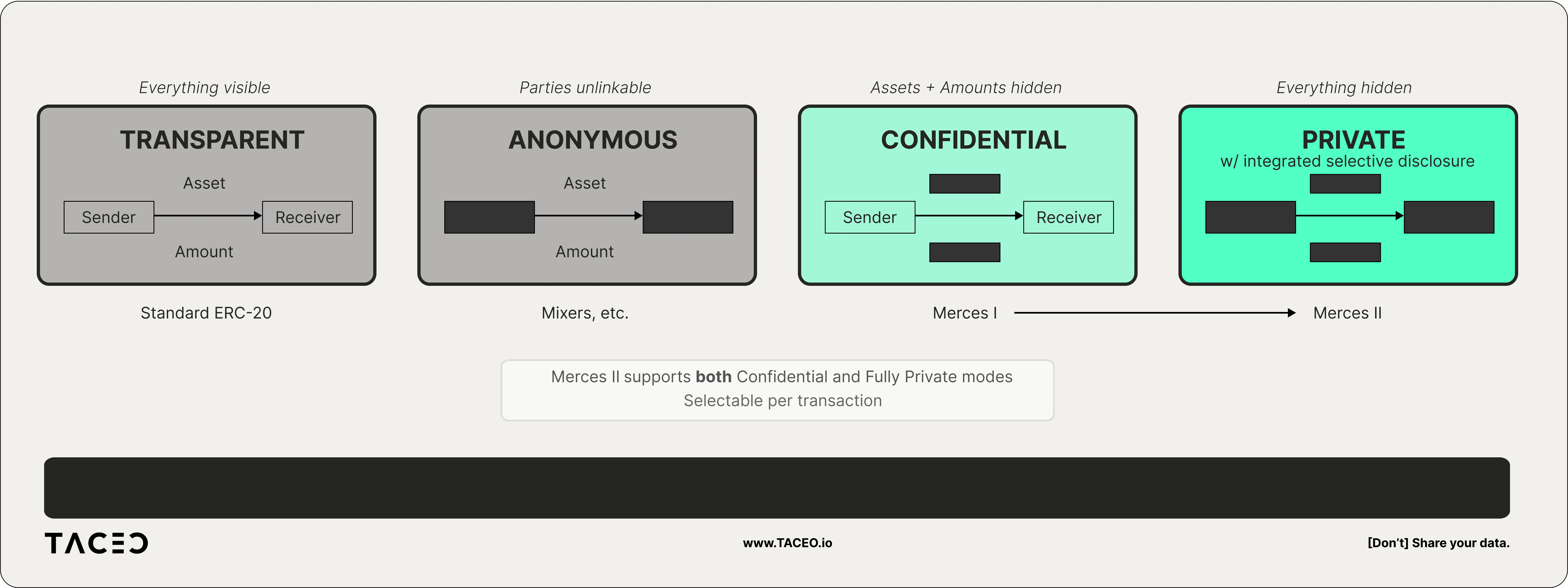
Onchain finance doesn’t need private transactions. It needs private accounts
Merces I: The First Step
Merces I was our first implementation. It is built it on the TACEO Network showing how stablecoin transfers hide transaction amounts while keeping sender and receiver visible onchain (what we refer to as confidential transfers). The system was deployed on Base and Arc testnets, operating at over 200 TPS.
This was always step one. And the feedback made that clear.
Across teams building wallets, payment systems, and financial infrastructure, the conclusion was consistent: Confidential transfers are useful, but insufficient. The transaction graph itself is sensitive infrastructure. Knowing who transacts with whom, even without amounts, reveals business relationships, salary structures, vendor dependencies, and competitive intelligence.
For serious financial systems, the transaction graph matters as much as the numbers.
The feedback was unambiguous: it’s not just about hiding amounts. It’s about private accounts, where balances, transfers, trades and counterparties are all invisible to outside observers. Onchain financial systems that operate like financial systems.
This is the shift from private payments to private financial systems.
Merces II: Private Accounts for Onchain Finance
Merces II implements a private account system for stablecoins on public blockchains. Deposit funds, and your balance is hidden. Your transfers are hidden. Your counterparties are hidden.
Transactions update balances, a cryptographic proof is verified onchain, and no external observer can tell who transacted with whom.
The system maintains a shared encrypted ledger of balances and transactions, updated offchain and verified onchain.
The application is deployed on the Plasma testnet, built using the TACEO Network’s OMap service. Today, it demonstrates fully private transfers: moving funds from a public wallet to a private wallet, transferring between users with all parties and amounts hidden, and moving funds back to a public wallet. Both confidential mode (“Merces I”-style, parties visible) and fully private mode (parties and amounts hidden) are available, selectable per transaction.
Transfers are the starting point. The private account model extends to the full range of financial operations: earn, pay, invest, trade, all with the same privacy guarantees. That’s the vision Merces is built to prove out.
The system integrates directly with existing EVM chains and requires no protocol-level modifications. It operates wherever the EVM does.
Unlike sharded systems or specialised chains, this model enables private execution on public rails, with cryptographic guarantees.
How It Works: Private State and Verifiable Execution
Private accounts are powered by an identity registry and a transaction architecture that maintains encrypted state with verifiable updates.
The user experience is straightforward:
- Connect: A user connects a wallet to the Merces application.
- Move: Transfer funds from a public wallet into the private account. The deposit amount is visible onchain (it’s a standard token transfer), but once inside, the balance is encrypted. On first move, the user is registered with a private identity within the TACEO Network. The system maintains a full encrypted transaction history that can support selective disclosure to authorized parties. Privacy by default, with auditability when required.
- Transfer: Transfers are executed privately. The TACEO Network verifies that the sender has sufficient balance, updates both parties’ balances within the encrypted state, and submits a cryptographic proof onchain. No information is revealed about the sender, receiver, or amount. Both confidential mode (parties visible, amounts hidden) and fully private mode (parties and amounts hidden) are supported.
- (optional) Withdraw: Move funds back to a standard public balance. The withdrawal amount becomes visible again, but nothing links it to any specific private transfer.
The model extends beyond transfers. Earn, pay, swap, invest, trade, all with the same privacy guarantees. These are the next steps.
The TACEO Network serves as the private execution layer, maintaining the private state, as it processes transfers, updates encrypted balances, and generates cryptographic proofs, but the contract on the host chain remains the source of truth. The onchain contract only accepts updates when the proof verifies.
Read more about the OMap and the Merkle tree of encrypted balances works in our post Introducing TACEO:OMap, and for a full view of the construction, read our paper A Private Verifiable Sparse Merkle Tree.
Compliance & Selective Disclosure
Privacy and accountability aren’t opposites, they’re design choices. The private account model is designed to support both.
The answer is selective disclosure. The TACEO Network maintains an encrypted transaction history, essentially a secret-shared transaction graph distributed across nodes. No single node has access to the full picture. But when an authorized party (say, a regulator with a valid request) needs to audit specific transactions, the architecture can support revealing exactly those transactions and nothing else.
Merces II includes a compliance dashboard that makes this tangible. An authorized auditor can view a defined set of transactions, or decrypt activity linked to a specific wallet address, without exposing anything beyond the scope of the query. This goes beyond the current ‘all-or-nothing’ paradigm, and reveals only the transactions that matter, to the parties authorized to check them.
This enables:
- Targeted audits without globally exposing data
- compliance with tracability or reporting requirements
- controlled access to financial activity
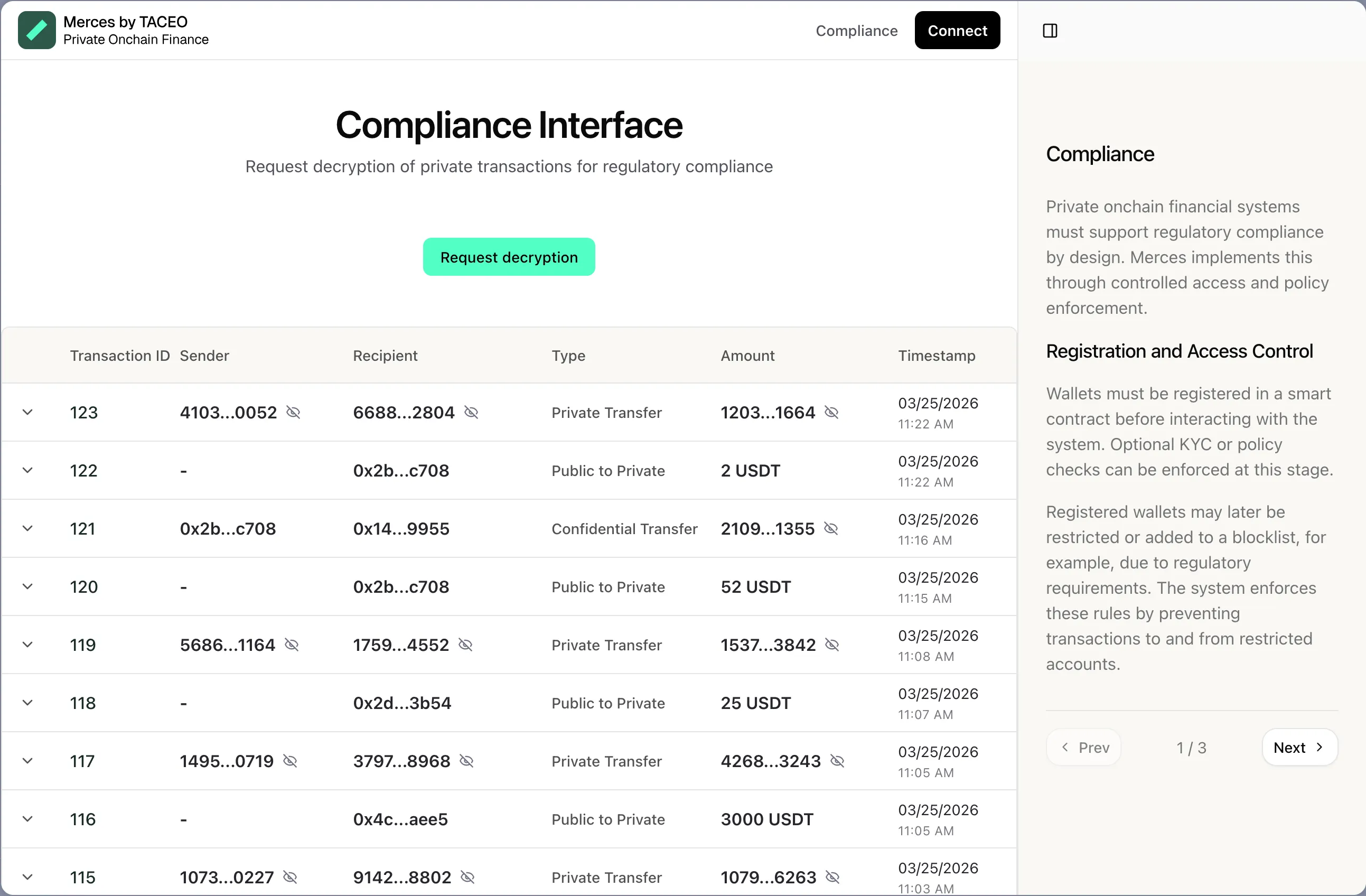
This avoids either extreme: full transparency (where everyone sees everything) or full opacity (where nobody can audit anything). The private account is private by default, auditable when required.
What a Private Account Can Do
Merces II supports private transfers in two modes: confidential (parties visible, amounts hidden) and fully private (everything hidden). Different use cases call for different levels of privacy: a domestic payroll run might use confidential mode; a cross-border settlement between institutions might require full privacy.
The private account model is designed to extend beyond transfers to the full range of onchain finance operations. Transfers are the foundation; the infrastructure to support what comes next is already in place.
A complete onchain finance experience also means addressing the operational questions that traditional finance has long answered: key management, account recovery, dispute resolution. These are active areas of design for the TACEO Network. The same infrastructure that supports selective disclosure for compliance can support recovery flows and delegated access.
What’s Next
Merces is a white-label solution for private and compliant onchain finance.
If you are building payment infrastructure, wallets, or financial systems on stablecoins, this is the execution layer for private financial systems. The TACEO Network is chain-agnostic. TACEO:OMap supports arbitrary private state. Merces is one implementation of a broader primitive.
Try the app: Merces II
Talk to us: [email protected]
Follow TACEO on X for the latest news.
